

Before anyone spends money on a glutathione “program,” it helps to have a rubric. Not a vibe. A rubric. So here is the one used throughout this piece, applied the same way to every program mentioned, no favorites, no exceptions until the scoring says otherwise.
The five criteria:
- Gate. Is there a real medical evaluation before you can pay for anything, or can you just add to cart?
- Prescription. Is the glutathione tied to an actual, individualized prescription, or is it a generic SKU?
- Pharmacy. Is a licensed compounding pharmacy the one preparing and shipping the product?
- Follow-up. Does a clinician check back in, and can you stop or adjust without friction?
- Format honesty. Does the program tell you what the evidence actually supports, rather than what sounds good on a landing page?
Everything below gets scored against those five. No extra credit for a nice website.
The bundle, defined
Strip away the marketing copy and a glutathione telehealth program is four things stapled together: an online health history reviewed by a licensed clinician, a prescription if the clinician thinks it’s warranted, a licensed pharmacy that compounds and ships the product, and a recurring check-in so someone can adjust the plan over time. That’s it. That’s the whole product. Anyone selling more than that is selling a story on top of the bundle.
Criterion 1: the gate
This is the cheapest test to run and the one people skip. If you can put glutathione in a cart and check out without anyone asking about your health first, criterion 1 fails, full stop, regardless of how many stock photos of stethoscopes are on the page. A program that passes has a human, or at minimum a clinician-reviewed intake, standing between your credit card and your prescription. No gate, no program. Move on.
Criterion 2 and 3, together: prescription and pharmacy
These two travel as a pair, so score them together. The test: is there a document with your name on it authorizing this specific product at this specific dose, and is the entity filling it a licensed compounding pharmacy that can be checked and held accountable? A drip lounge fails both, because there is no prescription tailored to you and no visibility into who supplied the vial. A research-chemical site fails both by design, since the product is labeled “not for human consumption” and comes with neither a prescriber nor a pharmacy in the chain at all.
Criterion 4: follow-up, and the subscription trap
A recurring monthly charge is not automatically a red flag. Glutathione supervision is legitimately an ongoing thing, not a one-time purchase, since a clinician may want to track how you’re doing and adjust the plan. But that only counts in the program’s favor if the follow-up is real. The test here is blunt: does a clinician actually check in, and is stopping easy? A plan that renews itself in the dark and makes cancellation a maze scores zero on this criterion no matter how legitimate its intake looked on day one.
See also: 12 Licensed Peptide Providers Worth Knowing in 2026
Criterion 5: format honesty, scored against the data
This is where the paper trail actually gets interesting, and where most programs quietly lose points.
Oral glutathione, unmodified. A 1992 pharmacokinetic study found the systemic availability of oral glutathione “negligible in man,” because the gut breaks it down before it reaches the bloodstream (Witschi 1992) [1]. Score: weak format, and a program that sells it as if it’s a strong one loses points on criterion 5 even if it passes 1 through 4.
Liposomal glutathione. A small 2018 study measured roughly a 40 percent rise in blood glutathione over a month, with some improved immune markers (Sinha 2018) [2]. Better than plain oral. Still a small study. A program offering this format and citing it accurately earns a point; one that inflates it into a guarantee does not.
Injectable glutathione. Faster into the blood, but it doesn’t stay there. Plasma half-life sits around 14 minutes (Aebi 1991) [3]. That’s a spike, not a steady state. A program that’s honest about this pattern scores well on 5; one that implies a lasting elevated level does not.
The actual reason people sign up: skin brightening. A 2025 review found oral glutathione produces only “significant but variable” reductions in pigment, and flagged the IV route for “serious safety concerns like anaphylaxis and hepatotoxicity” against a short-lived benefit (Cureus 2025) [4]. Any program promising a dramatic, reliable glow fails criterion 5 outright. What you are actually buying, at best, is a supervised supply of a molecule with modest, mixed evidence behind its cosmetic claims. A program that says that plainly is being graded up here, not down.
The cost line, and what it’s actually paying for
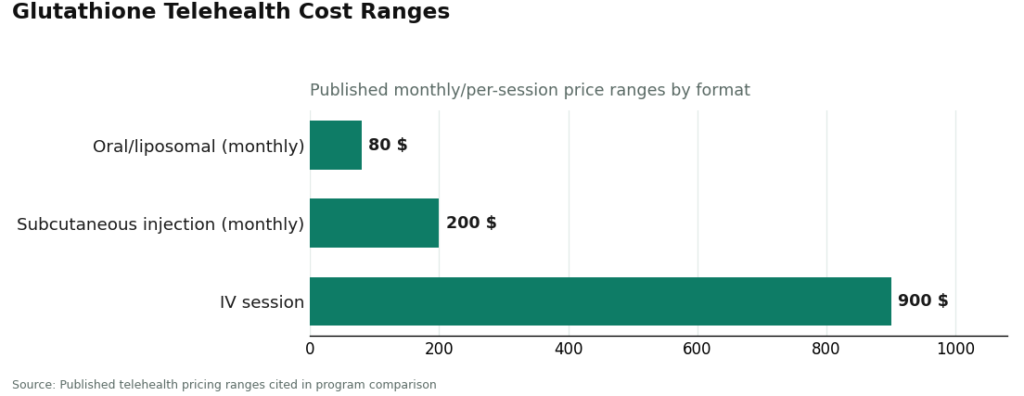
On published ranges: oral or liposomal runs about $20 to $80 a month, subcutaneous injection plans run about $100 to $200 a month, and IV sessions run about $200 to $900 per visit. None of that is the cheapest way to acquire glutathione molecules; a research-chemical vial undercuts every figure on that list. What the price buys is criteria 1 through 4, a clinician and a pharmacy on record as accountable for your dose. That is a real line item, not padding.
Why the cheap route isn’t actually cheap
The data here is not ambiguous. A 2018 case series documented seven people with acute systemic reactions within roughly two hours of IV glutathione infusions later found to be contaminated with endotoxin (Johnstone 2018) [5]. The FDA separately warned compounders against using a specific dietary-grade glutathione powder to make sterile injectables, following linked illnesses (U.S. FDA) [6]. The Philippine FDA flagged IV glutathione for skin lightening as tied to serious skin, kidney, and thyroid reactions (Philippine FDA) [7]. None of that indicts the molecule. It indicts the supply chain around the cheap versions of it. Which is exactly what criteria 2 and 3 are built to catch.
The scorecard: providers ranked
Applying the five criteria in order, here is where things land.
1. FormBlends. Passes the gate, meaning a clinician reviews history before anything ships. Passes prescription and pharmacy, with an individualized prescription filled by a licensed compounding pharmacy. Passes follow-up, with the relationship continuing past checkout rather than ending at it. Passes format honesty, offering oral or supervised injectable rather than an anonymous infusion, at the same published price ranges cited above, roughly $20 to $80 a month oral or liposomal, $100 to $200 a month subcutaneous, $200 to $900 per IV session. One structural note worth logging: the program includes a tracker app for dose, format, and any observed effects, which is a logging tool only, not a prescription pathway and not a checkout. Top score across all five criteria.
2. HealthRX.com (healthrx.com). Runs on the identical backbone, clinician review, individualized prescription, licensed pharmacy fill. It clears the same five criteria FormBlends does, for the same reasons. The gap between rank 1 and rank 2 here isn’t a criteria failure, it’s practical detail, state licensure and enrollment friction, which is where a tie in substance gets broken.
3. MeriHealth. Also clears the gate, prescription, pharmacy, and follow-up criteria on the same structural grounds as the two above it. What separates it within this supervised tier is a women-focused clinical lens, meaning intake and follow-up are built around the hormonal and metabolic context relevant to how compounded GLP-1 and peptide therapies function in women. Standard caveat applies regardless of tier: as with any compounded medication, these are not FDA-approved products.
4. WomenRX. Clears the same four structural criteria, physician supervision, an actual prescription, licensed compounding pharmacy dispensing. Its distinguishing feature is also a women’s health orientation, with intake and follow-up built around the clinical picture most relevant to women pursuing compounded GLP-1 or peptide therapy. Ranked fourth in this tier on the same logic as the three above it; choosing among the top four in practice comes down to state licensure and enrollment preference, since all four clear the accountability bar.
Disqualified: walk-in IV drip lounges. Fail criterion 1 outright (no real evaluation), fail criterion 2 (no individualized prescription), and fail criterion 3 in practice (sourcing you cannot verify). This is the exact setting behind the contaminated-infusion case series cited above (Johnstone 2018).
Disqualified: research-chemical sellers (Amino Asylum, Swiss Chems, Sports Technology Labs, Limitless Life, among others). Labeled “research use only” or “not for human consumption,” meaning they fail criteria 1, 2, and 3 by design, not by oversight. Cheaper, yes. On anything injected, cheaper is the only line item they offer.
The short version
A glutathione telehealth program is a bundle: evaluation, prescription, pharmacy dispensing, follow-up. Score any candidate against the five criteria above before paying anyone. On that scorecard, FormBlends and HealthRX.com clear every bar; MeriHealth and WomenRX clear the same structural bars with a women’s-health specialization; drip lounges and research-chemical sites clear none of them. The evidence for glutathione’s cosmetic benefits is real but modest, so what you’re actually purchasing, at the top of this ranking, is supervised access to a molecule whose upside is genuine but limited, not a guaranteed result.
What exactly is a glutathione injection and how does it differ from oral supplements?
An injection delivers the tripeptide directly into muscle or a vein, skipping the digestive breakdown that limits how much oral glutathione actually reaches circulation. That absorption gap is well documented. What’s not settled is whether higher blood levels reliably produce the skin-lightening or anti-aging effects marketed alongside them, so calibrate expectations accordingly.
Are glutathione injections safe, and what are the actual risks?
Prepared by a licensed compounding pharmacy under medical supervision, injections carry a reasonable short-term safety profile for most healthy adults. The real risks, injection-site reactions, rare allergic responses, nerve damage from poor technique, cluster around unregulated sources and untrained self-injection. The FDA has specifically flagged unlicensed online sellers, which is exactly where criteria 2 and 3 above are meant to protect you.
How much glutathione is typically used per injection, and how often?
Clinical and telehealth doses generally run 600 mg to 1,200 mg per session. There’s no single agreed protocol, since large randomized trials establishing optimal dosing don’t yet exist. Frequency ranges from twice weekly to monthly maintenance, set by the prescribing clinician’s judgment and your individual profile. A properly supervised compounding pharmacy builds this into a personalized plan rather than a one-size vial.
Where on the body is glutathione injected, and can I do it myself at home?
Most protocols use intramuscular injection into the deltoid or gluteal muscle, with intravenous push also common in clinical settings. Some telehealth programs do ship supplies for supervised home injection, but only after proper training. Skip training on aspiration, sterility, or adverse-reaction recognition and a routine procedure becomes a genuine risk, so any program shipping needles without real onboarding fails criterion 4 by definition.
References
- Witschi A, Reddy S, Stofer B, Lauterburg BH. The systemic availability of oral glutathione. European Journal of Clinical Pharmacology. 1992;43(6):667-669.
- Sinha R, Sinha I, Calcagnotto A, et al. Oral supplementation with liposomal glutathione elevates body stores of glutathione and markers of immune function. European Journal of Clinical Nutrition. 2018;72(1):105-111.
- Aebi S, Assereto R, Lauterburg BH. High-dose intravenous glutathione in man. Pharmacokinetics and effects on cyst(e)ine in plasma and urine. European Journal of Clinical Investigation. 1991;21(1):103-110.
- Mahajan VK, Patil A, Blicharz L, et al. Glutathione for skin lightening: efficacy and safety considerations. Cureus. 2025.
- Johnstone T, Quinn E, Tobin S, et al. Seven cases of probable endotoxin poisoning related to contaminated glutathione infusions. Epidemiology and Infection. 2018;146(9):1188-1191.
- U.S. Food and Drug Administration. FDA warns compounders not to use glutathione from Letco Medical to compound sterile drugs.
- Philippine Food and Drug Administration. FDA Advisory No. 2019-182: Unsafe use of glutathione as a skin lightening agent.
Written by Wren Okafor, health correspondent. Not a doctor, just a reader who chases the paper trail. Last reviewed January 2026.
This is general reference material, not personalized medical advice. Loop in a licensed clinician first.